BESS (Battery Energy Storage System) technology is based on the use of electrochemical batteries, which can store the energy produced by renewable energy plants. They are a kind of power bank that can return the stored energy on demand.
BESS are one of the main energy storage systems.
They are also known as electrochemical energy systems. This is in order to distinguish them from others, such as gravitational energy systems (including pumped hydroelectric power plants), mechanical energy systems (including compressed air or flywheel systems), and thermal energy systems (Thermal Energy Storage, TES).
As in all storage systems, in BESS, the electricity produced by a power plant or any other generation method – even a single photovoltaic panel – is stored and then released at the desired times and moments.
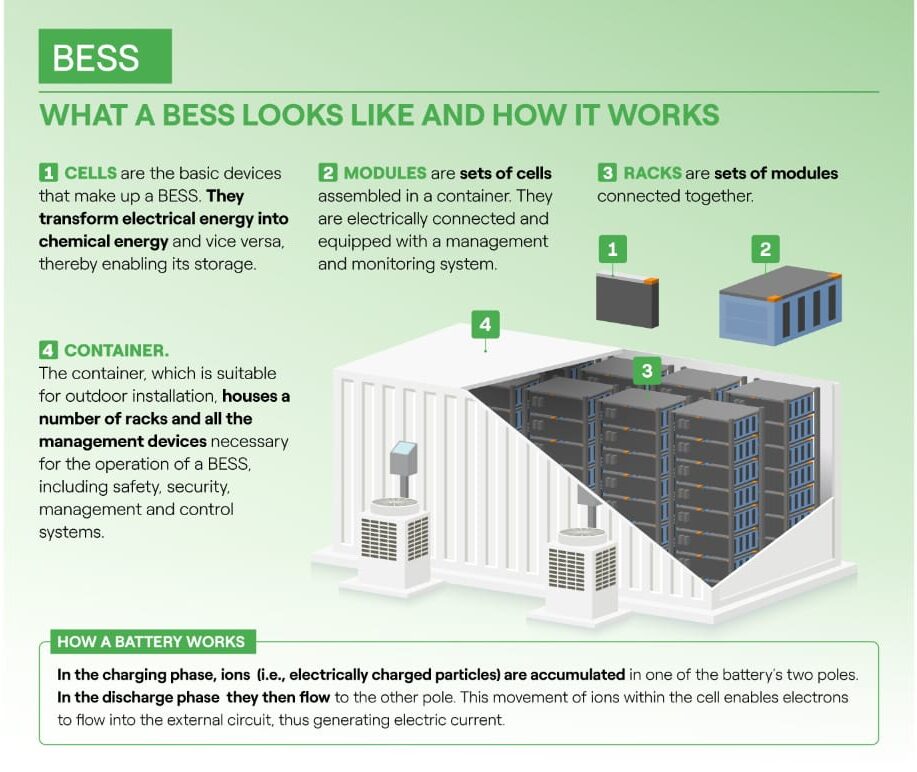
The specificity of BESS lies in the technique used for storage: since electric current is a flow of electrical charges, a battery is charged by accumulating the charges of particular materials (called electrolytes) in one of the two poles, from which they then flow to the other pole during the discharge phase.